
The complete guide
How to Choose a Wagon Wheel Chandelier for a Big Room
The problem with big rooms and small lights
Walk into a room with a high ceiling and one modest light in the middle, and something feels off. The ceiling looks empty. The corners sit in shadow. You can add lamps, and lamps help, but they only fix the bottom half of the room. The upper space still reads as blank.
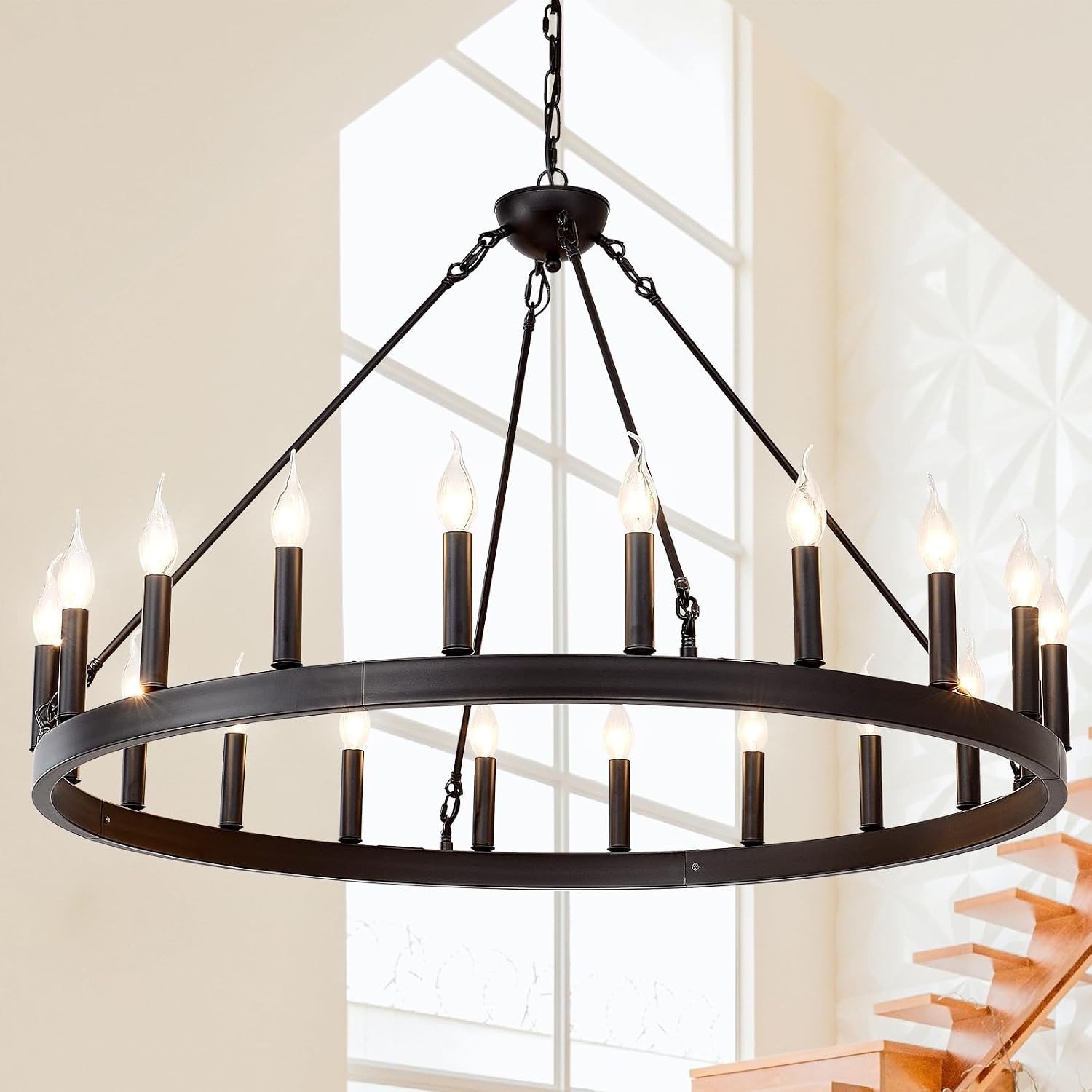
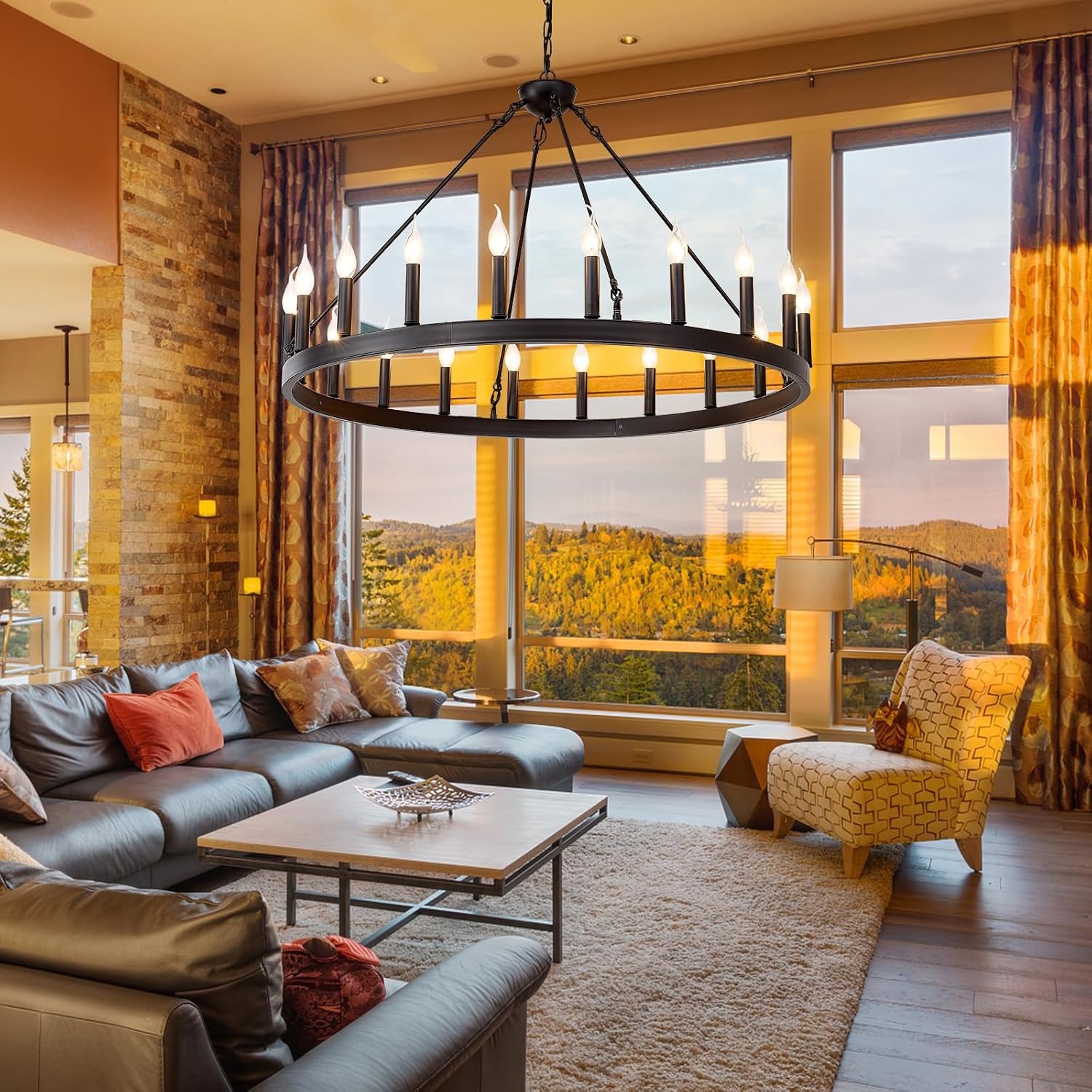
That gap is exactly what a large chandelier is for. It gives the eye something to land on at height, and it pushes light outward rather than straight down in a narrow cone. A 40 inch wagon wheel does both at once. The wide ring carries the light to the edges of the room, and the dark metal frame gives the ceiling a shape instead of a blank plane.
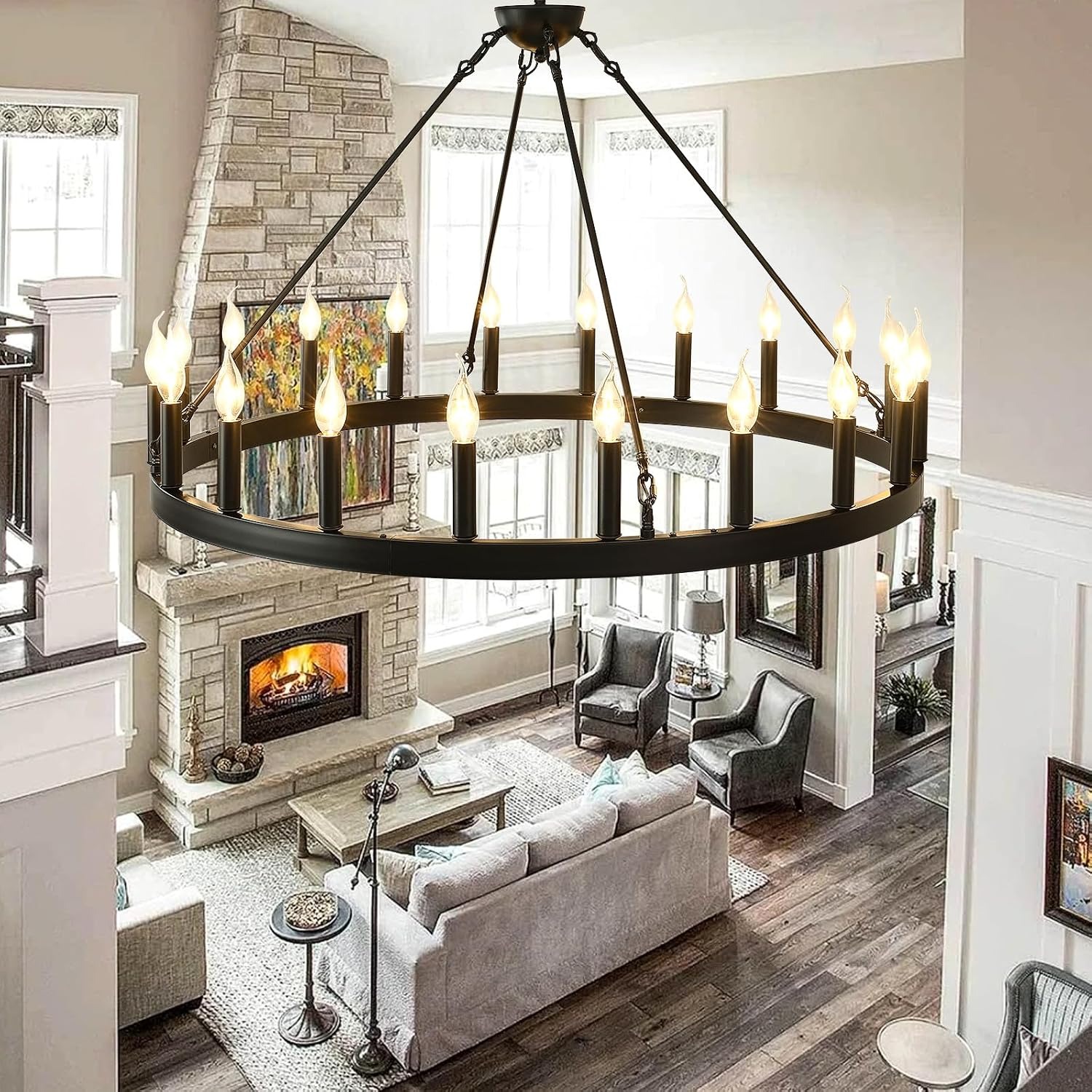
This matters most in three places. Double-height entries, where there is a lot of vertical air and nothing in it. Open-plan living and dining rooms, where one fitting has to serve a wide area. And long dining tables, where you want the whole surface lit, not just the middle two seats.
How a wagon wheel chandelier actually works
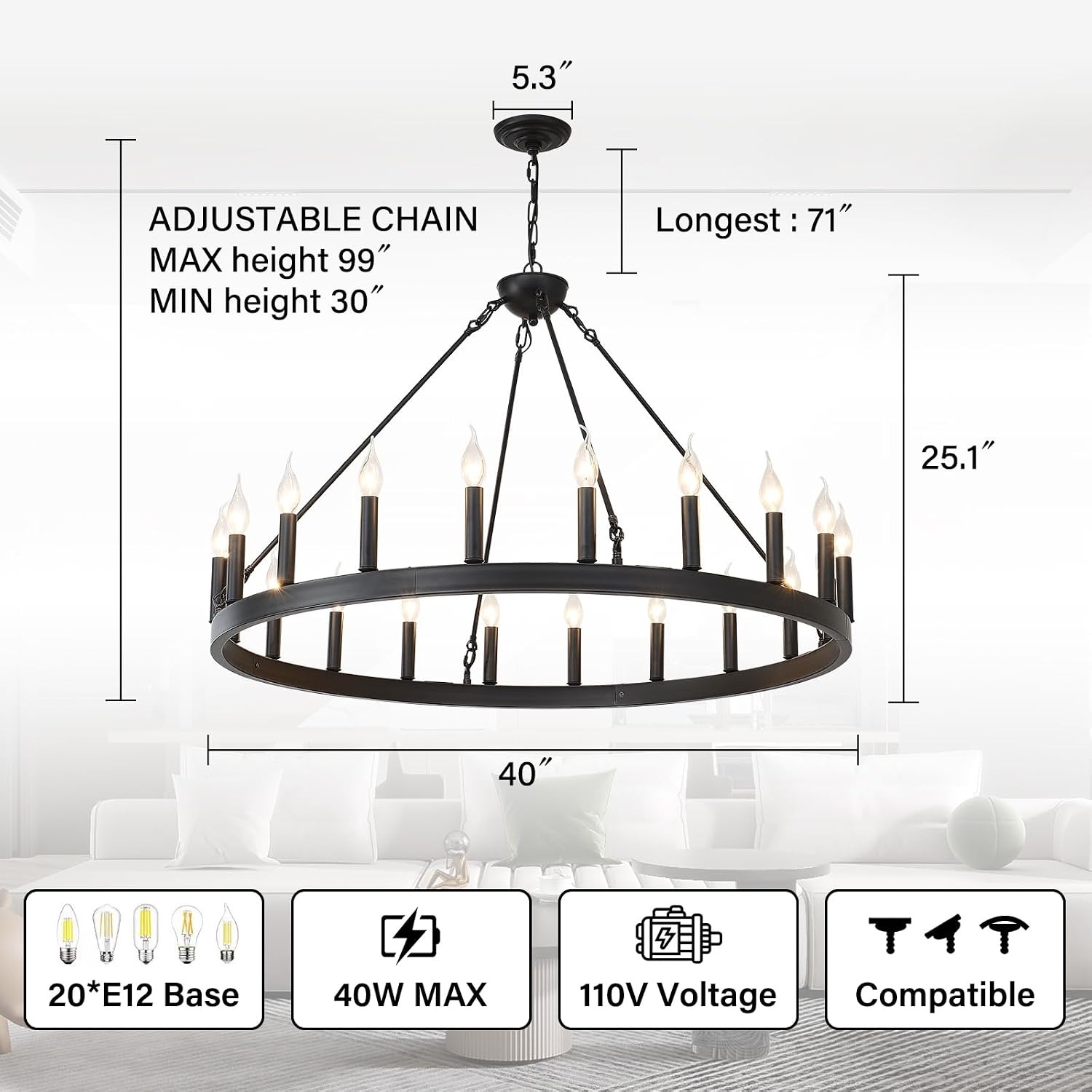
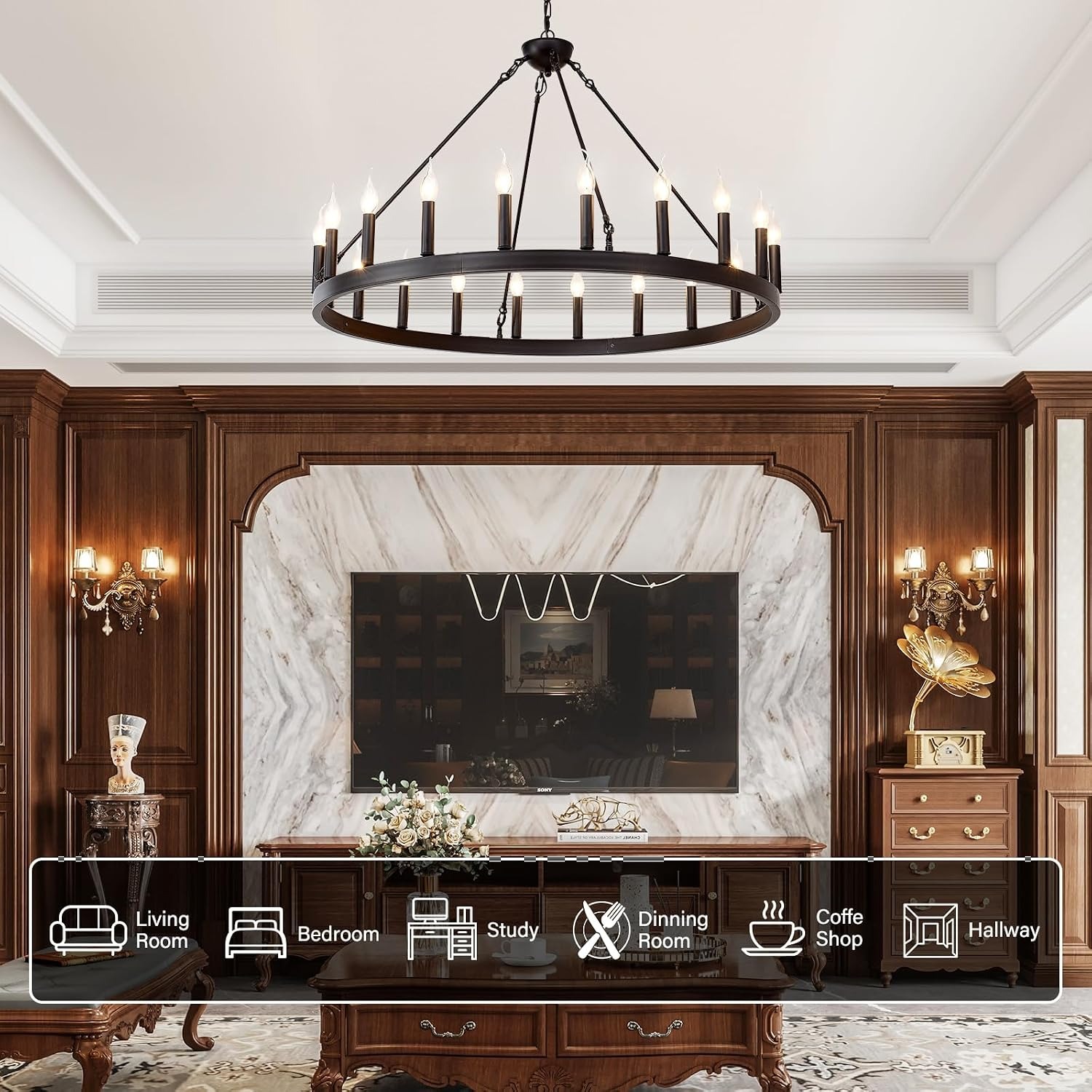
The idea is simple. A circular metal frame, spokes running in to a hub, and light sockets spaced around the outer ring. On this one there are twenty E12 candelabra sockets, each rated up to 40 watts.
Twenty points of light spaced around a 40 inch circle behaves very differently from one bright bulb in the center. The light overlaps as it falls, so you get fewer hard shadows and a softer finish across a table or a floor. It is the same reason a row of downlights beats a single bare bulb.
There are no shades or diffusers, which is part of the look. The bulbs are visible, candle-style, sitting on the ring. That means the bulbs you choose are a real design decision, not an afterthought. Clear glass bulbs with a visible filament look vintage. Frosted bulbs give a softer, calmer glow. Both work, they just set a different tone.
Bulbs are not included. That sounds like a catch, but it is genuinely useful. You get to set the brightness and the color temperature for your room instead of living with whatever came in the box. Warm white for dining and living areas. Neutral for kitchens. Cooler for offices and work spaces.
Hanging height and ceilings
The chain comes in three sections, and that is the feature that makes this fixture flexible. The hanging drop adjusts from roughly 30 inches to 99 inches below the ceiling, with a listed maximum overall height of 106 inches.
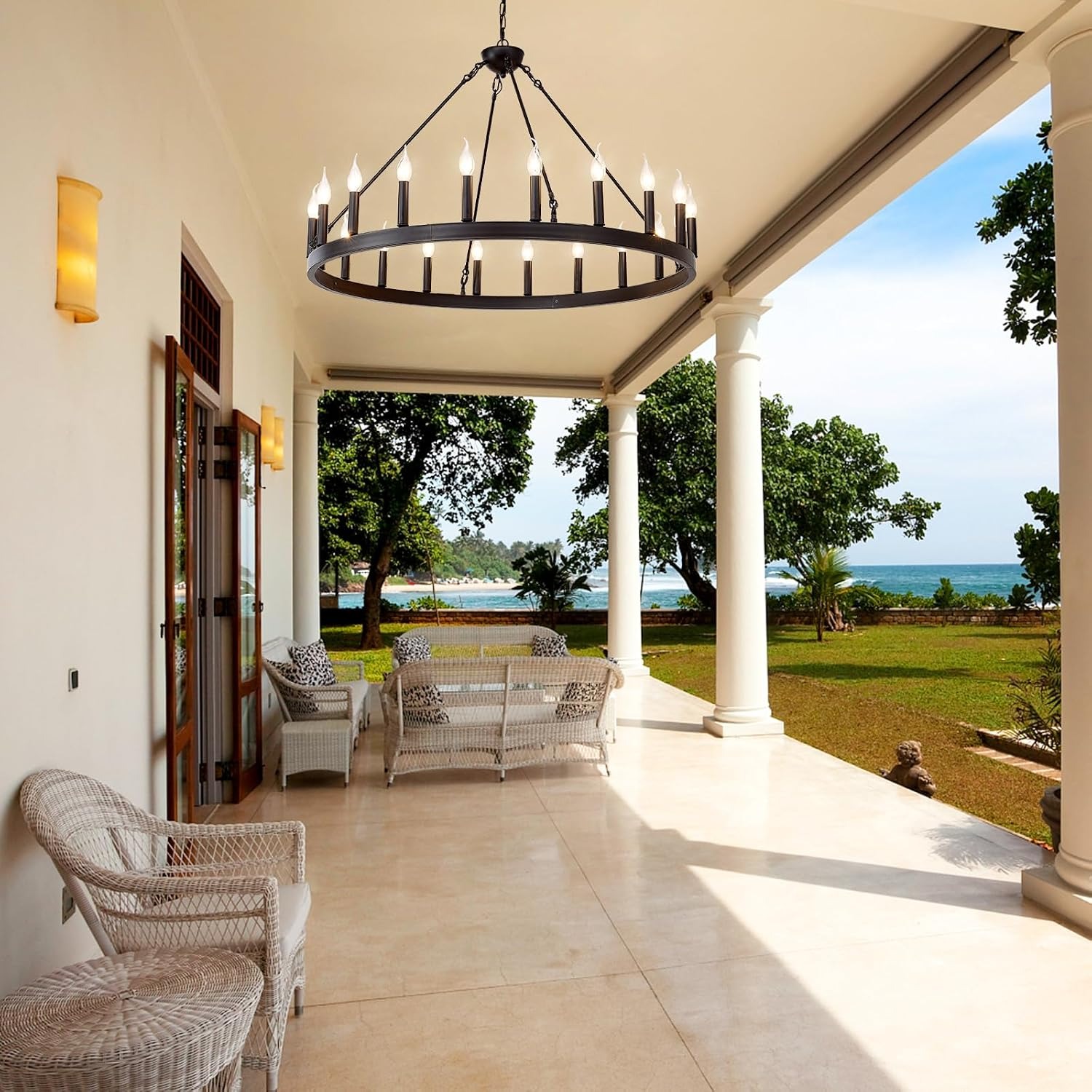
The canopy suits flat, sloped, angled and vaulted ceilings. Chain-hung lights hang straight down no matter what the ceiling is doing above them, so an angled ceiling is not a problem as long as the canopy can sit flush against it.
For a dining table, the usual rule is the bottom of the fixture around 30 to 36 inches above the tabletop. Taller ceilings can take a little more. For a hallway or a living room where people walk underneath, keep at least seven feet of clear headroom, and more if anyone in the house is tall.
In a two-story entry, you have more freedom. A common approach is to center the fixture roughly in the vertical space, or to line it up so it reads nicely from the landing and the front door. Think about access too. If you need a tall ladder or scaffolding to change a bulb, long-life LED bulbs are worth the extra cost up front.
Will it fit your room?
Size is where people get caught out. A 40 inch wheel is big, and photos flatten scale.
For a dining table, the chandelier should be narrower than the table. A 40 inch fixture generally suits a table around 72 inches long or more. Over a shorter table it will overhang and feel crowded.
For a living room or entry, a common sizing method is to add the room length and width in feet, then treat that number in inches as a reasonable chandelier diameter. A room that is 18 by 20 feet gives you 38 inches, which lands right at this size. A small room that gives you 24 inches will be overwhelmed by a 40 inch wheel.
Then there is ceiling height. You need the fixture height plus headroom. In a standard 8 foot room, this piece will sit close to the ceiling on its shortest chain setting, which some people like and others find heavy. It really comes into its own from 10 feet up.
Choosing bulbs
Twenty sockets is a lot of decisions in one go, so here is the short path.
Pick LED candle bulbs with an E12 base. They run cool, they use a fraction of the power, and across twenty sockets that difference adds up on a power bill. Stay within the 40 watt rating.
Decide on color temperature. Around 2700K is warm and yellow-toned, good for dining and living rooms. Around 3000K is slightly crisper. Above 4000K starts to feel like an office.
If you want dimming, buy bulbs explicitly labeled dimmable and pair them with a compatible dimmer switch. Non-dimmable LEDs on a dimmer flicker and buzz. The fixture dims fine, but only with the right parts on both ends.
Buy a spare or two at the same time. Matching bulbs years later is harder than it sounds, and one odd bulb in a visible ring of twenty is obvious from across the room.
Installing it
This is a hardwired ceiling fixture, which means power off at the breaker, a properly rated ceiling box, and a mounting point that will carry the weight. The accessory kit and the user manual come in the box.
A few practical notes. Work out your chain length before you lift anything, because adjusting it while holding the fixture overhead is miserable. Have a second person. And in many places, hardwired lighting work legally needs a licensed electrician, so check your local rules before you start.
The fixture is listed as UL specification met, rated 110 volts, and is indoor only. It is not water resistant, so bathrooms with poor ventilation and covered outdoor areas are both a no.
Keeping it looking good
Open metal frames are easy. There is no glass to wash and no fabric to yellow.
Turn the power off and let the bulbs cool. Dust the frame with a dry microfibre cloth, working around the ring and the spokes. For marks, use a cloth lightly dampened with warm water, then dry it straight away so nothing sits on the paint. Avoid solvents, bleach and scouring pads.
Once or twice a year, check that the canopy and chain fixings are still firm. It takes two minutes and it is the kind of maintenance people forget on a fixture they never touch.
Who it suits, and who it does not
It suits people with height and floor space, who want one piece to anchor a room. It works in farmhouse, rustic, industrial and country interiors, and it holds its own in modern rooms that mix materials. If you have been looking for the best chandelier for high ceilings and keep finding fixtures that are too small or too fussy, a plain black wheel is a straightforward answer.
It does not suit small rooms, low ceilings, or anyone who wants a quiet light they never notice. This is a statement piece. It also does not suit people who want to unbox and plug in, since it needs hardwiring and twenty bulbs you supply yourself.
The short version
A 40 inch painted black metal wheel with twenty E12 sockets, up to 40 watts each. Three-section chain, adjustable drop from roughly 30 to 99 inches, and a canopy for flat, sloped, angled or vaulted ceilings. Indoor only, 110 volts, hardwired, UL specification met, with a 2 year manufacturer warranty. Bulbs and dimmer are not included, which gives you control over the light.
Measure your room and table first. If the numbers work, this is a lot of chandelier for the space it fills.